2025
Reminiscence
Memories play a central role in shaping human identity and influencing daily decision-making, perception, and interaction.
Childhood memories, in particular, hold deep emotional significance and form the foundation of personal development and self-understanding. Despite their importance, they are rarely reflected upon in day-to-day life.
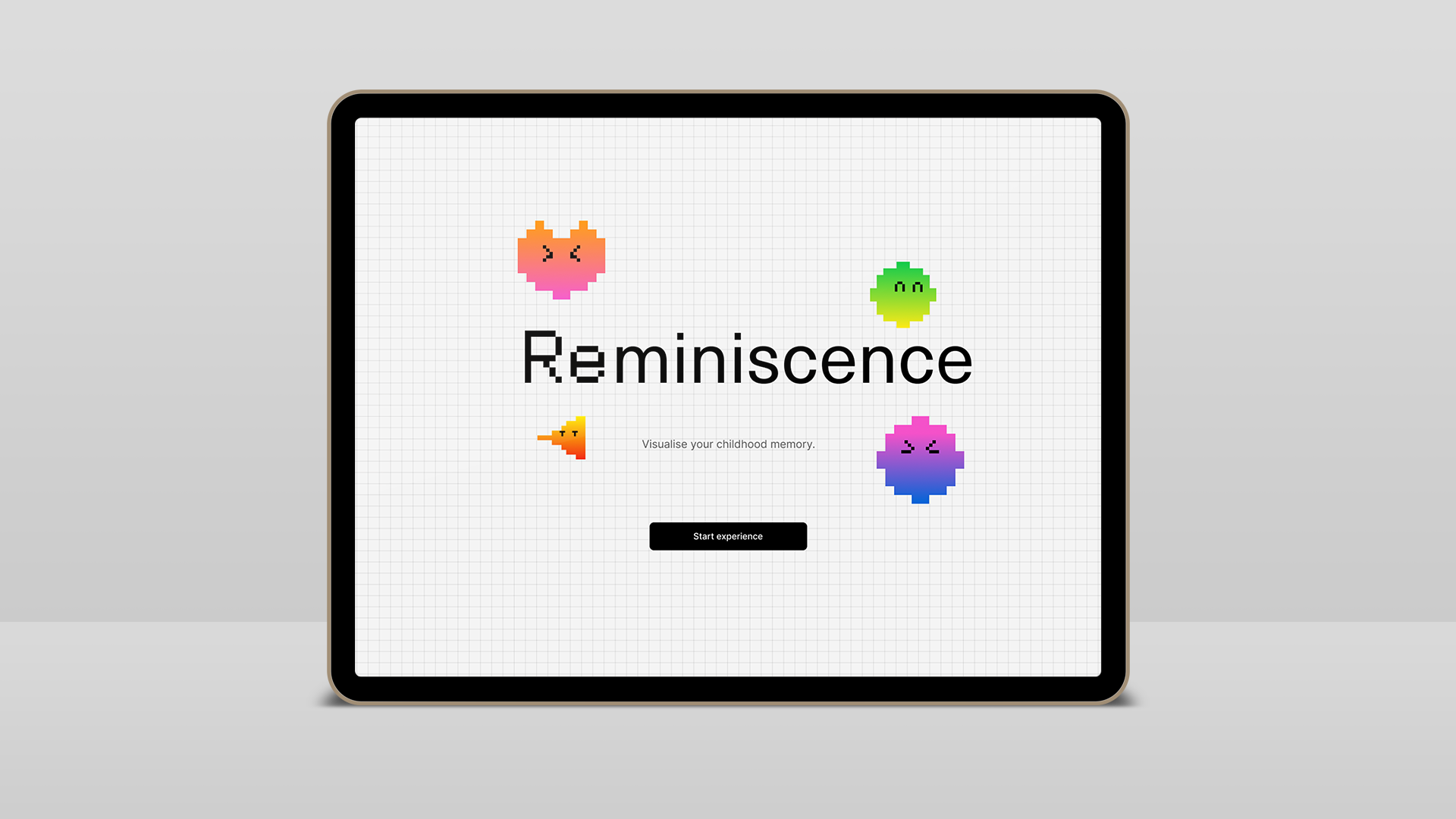
This project investigates the relationship between memory and emotion through the development of an interactive, user-centred installation titled Reminiscence. The installation provides a reflective space for users to revisit and visualise their childhood memories, fostering appreciation for the emotions and experiences that define them.
Through research-led design and iterative experimentation, the project explores how interaction design can evoke personal reflection and emotional connection.
The brief:
“Investigate a creative project that explores a context subject and medium within the field of media design. This project is self lead and experiment based to create a design collateral that answers a research question.”
Research question:
“How might I create an installation using emotional design theory to visualise and connect people through their childhood memories?”
Why?:
The motivation for this project is to preserve memories, foster appreciation of them as valuable artefacts, highlight the richness of other people’s experiences, and build a shared archive like a gallery that can spark new connections and emotions in others.
This project was experiment based, each week exploring various avenues within the research question defined in week 1.
Inspiration
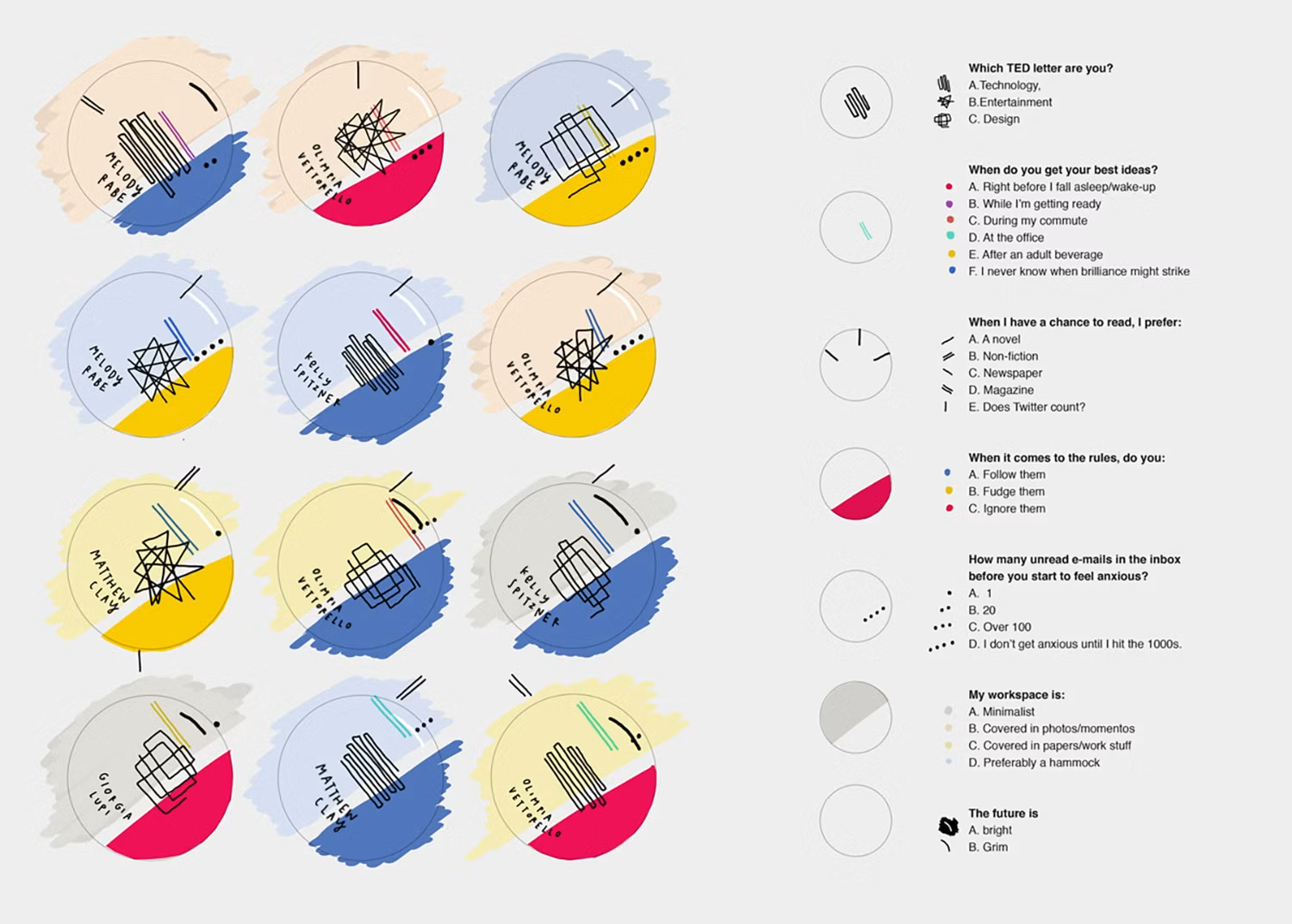
As the foundation of this installation, the project drew inspiration from Giorgia Lupi’s Data Portraits (Lupi & Posavec, 2017). Lupi’s work demonstrates how data can be used as a medium for storytelling, transforming personal information into expressive and human-centred visuals. In her methodology, participants answer a series of questions, and the resulting data is translated into a unique visual form that reflects the individuality of each person. Similarly, Reminiscence adapts this approach by asking users questions about their childhood memories, such as how events occurred, what emotions were felt, and what sensory elements stood out. Each response influences the resulting visualisation, meaning that every user outcome is unique. This process reinforces the individuality of memory while collectively forming an evolving digital landscape that represents shared human experience.
Experiment 1
Concept development
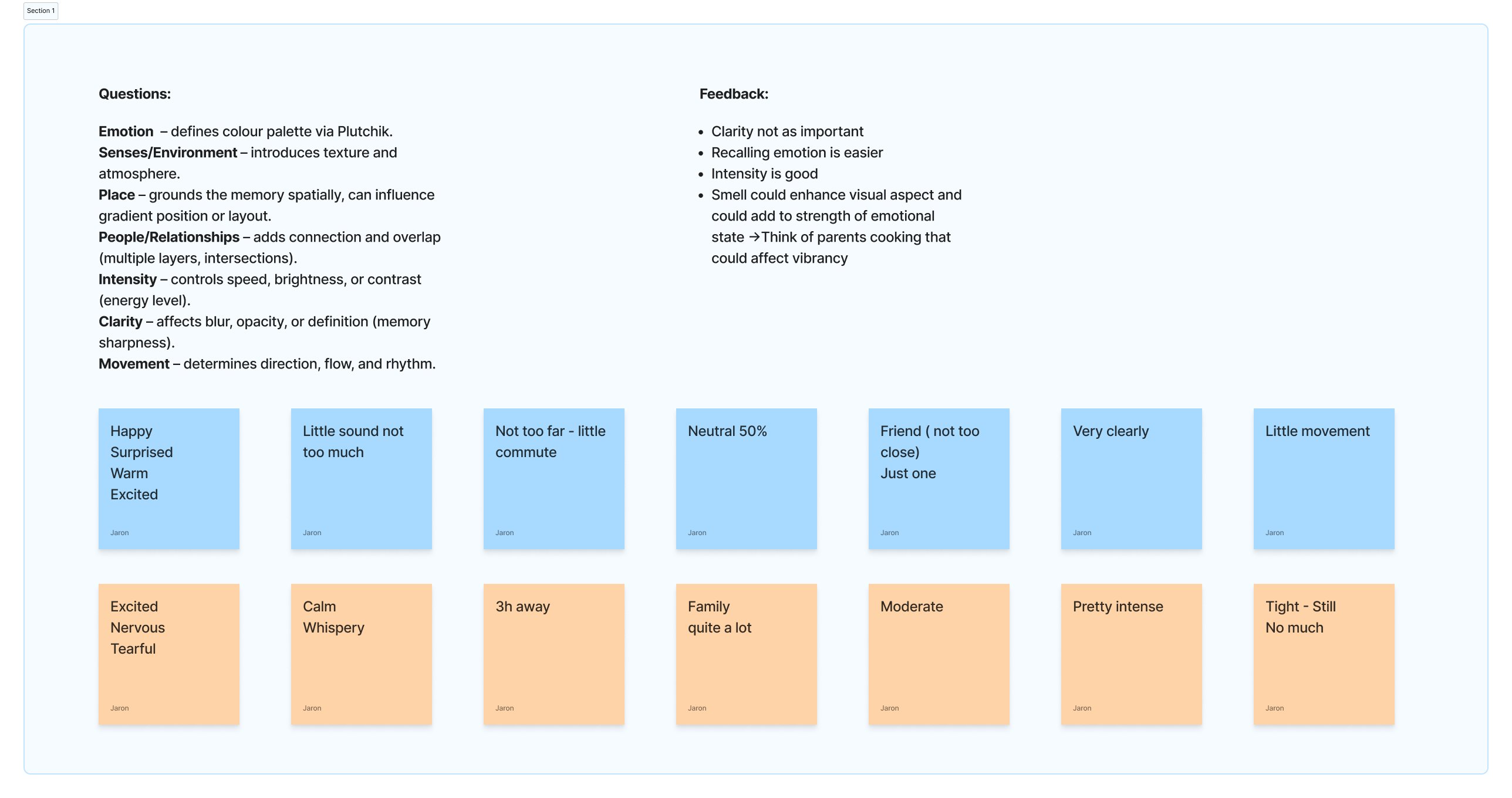
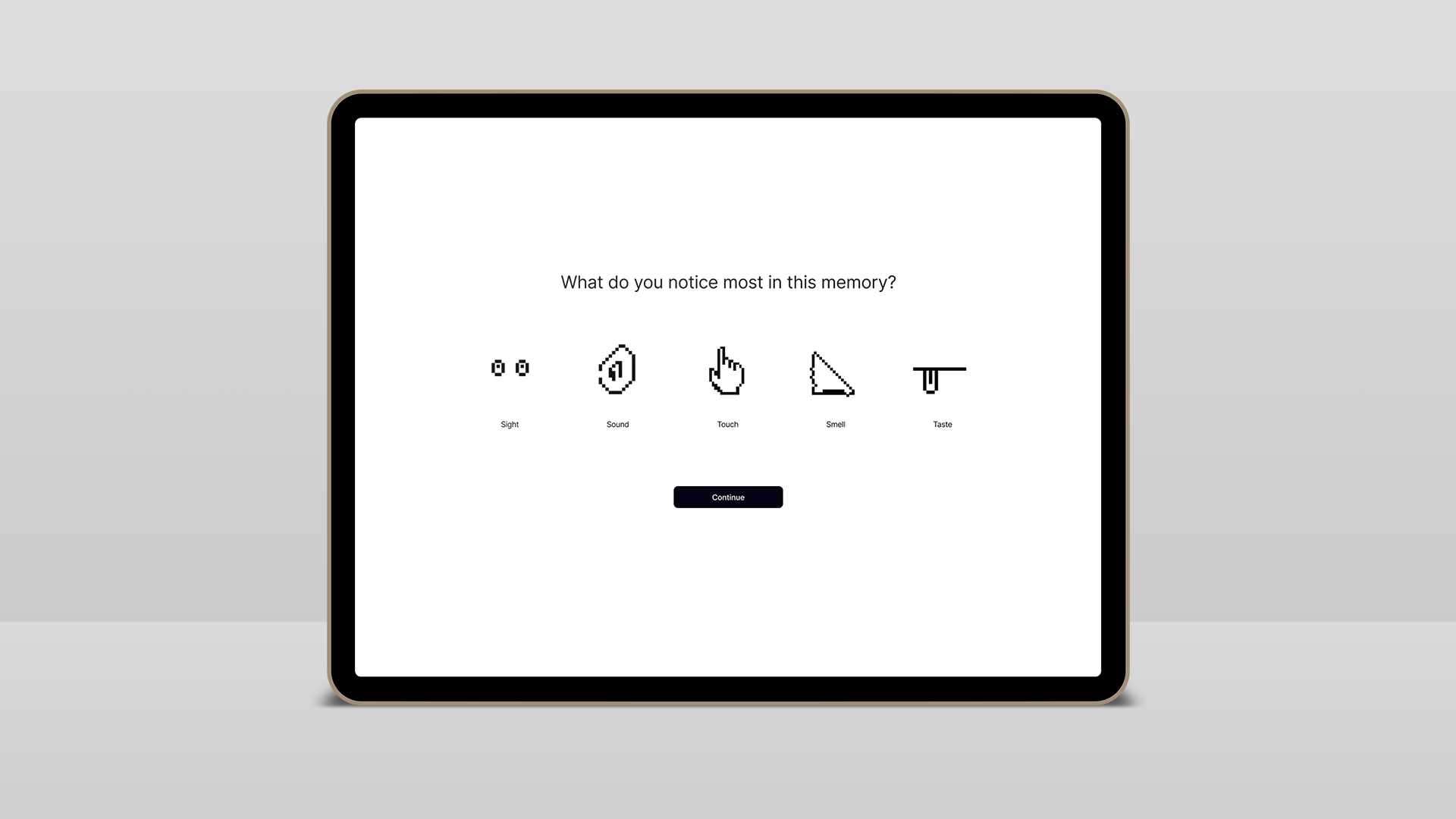
The first experiment began with the creation of a series of questions designed to encourage participants to recall and visualise a specific childhood memory. The aim was to gain insight into which sensory and emotional elements were most prominent in their recollections.
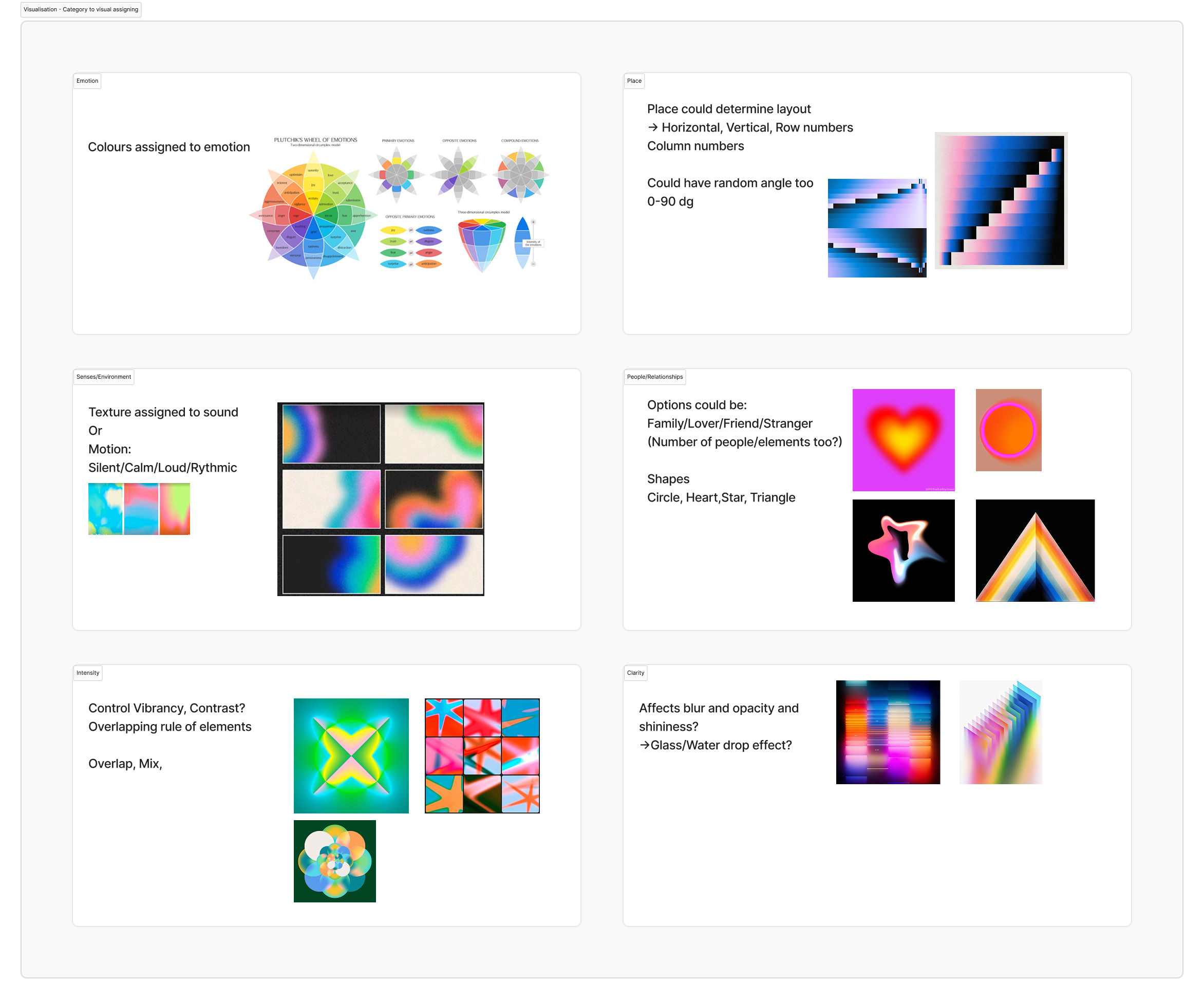
A visual system using colour gradients was developed, with each gradient corresponding to the participant’s answers. User testing was conducted with multiple participants who were asked to describe a memory and articulate what they could remember about it. Their responses were then translated into visual outputs based on the gradient system. Results indicated that many participants found the concept of “memories” too broad, which made it difficult for them to provide specific answers. Consequently, the visual results appeared shallow and lacked conceptual depth. To address this limitation and strengthen the emotional and narrative quality of the project, an additional illustrative and visual design experiment was undertaken in the following phase.
Experiment 2
Visual design
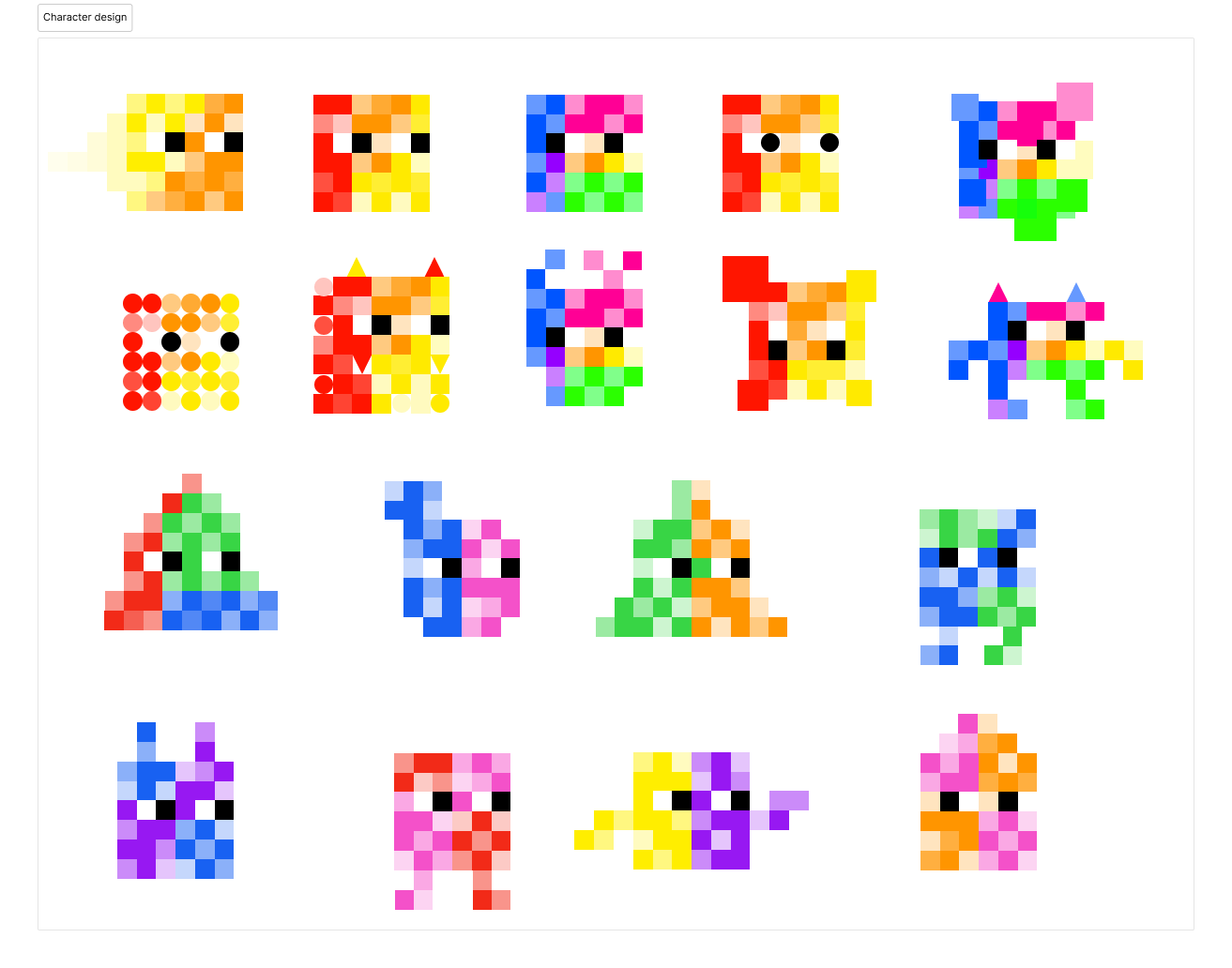
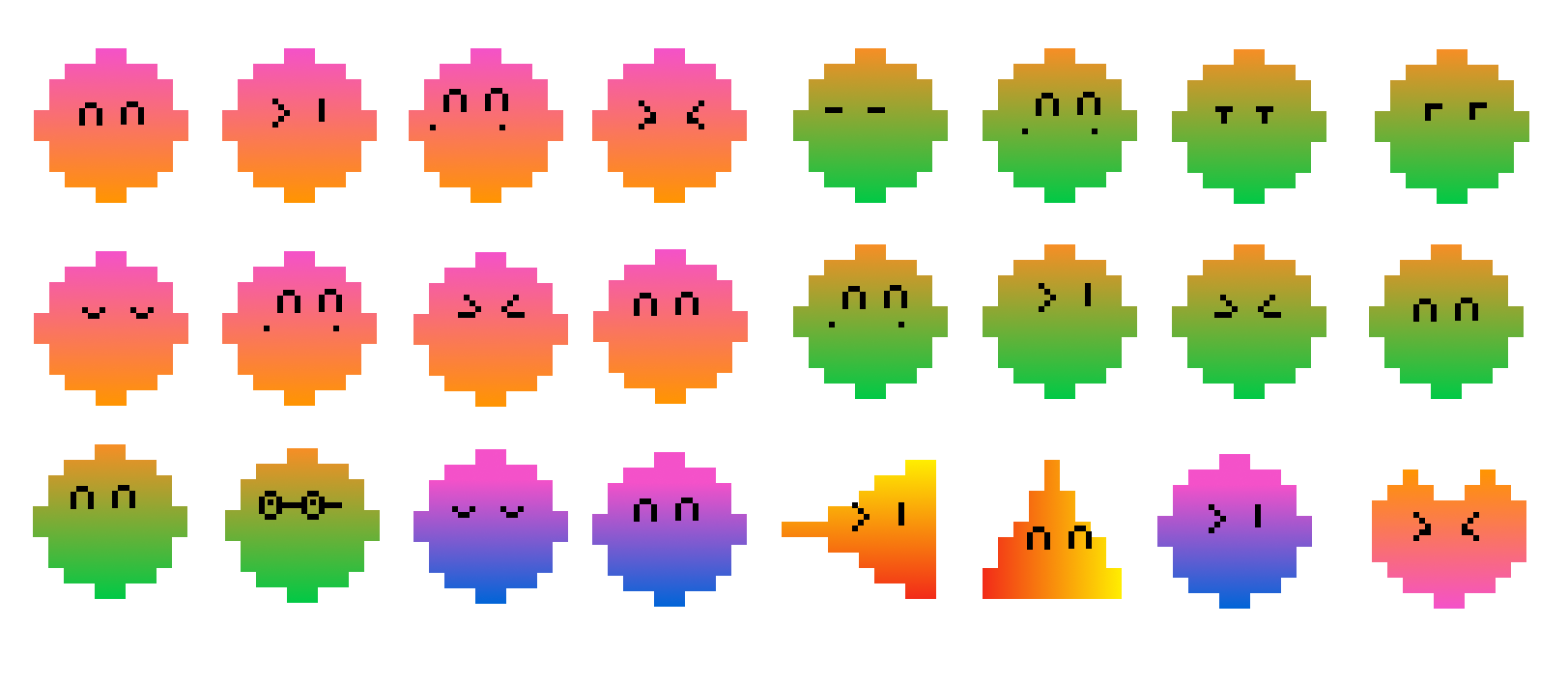
To add more conceptual depth to the project, a range of visual design styles was explored. The most suitable direction was found to be the creation of pixel art characters, which aligned closely with the concept of visualising and connecting people through childhood memories. An illustrative visual experiment was conducted to test multiple styles and variations.
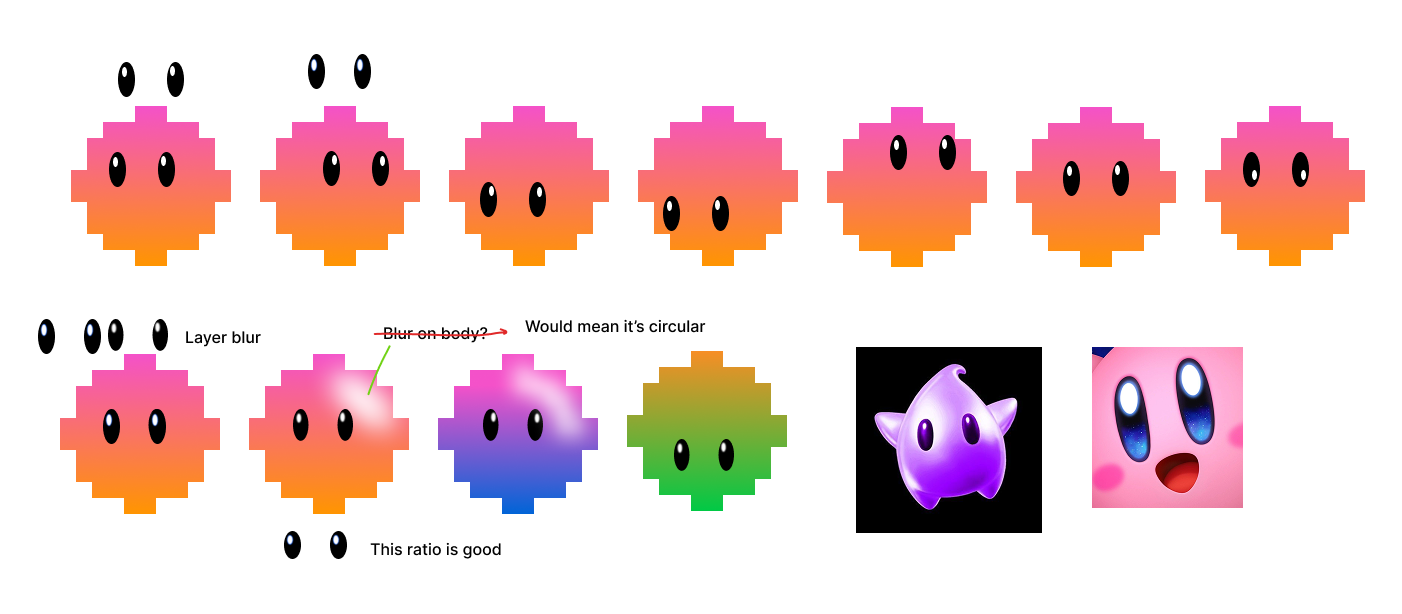
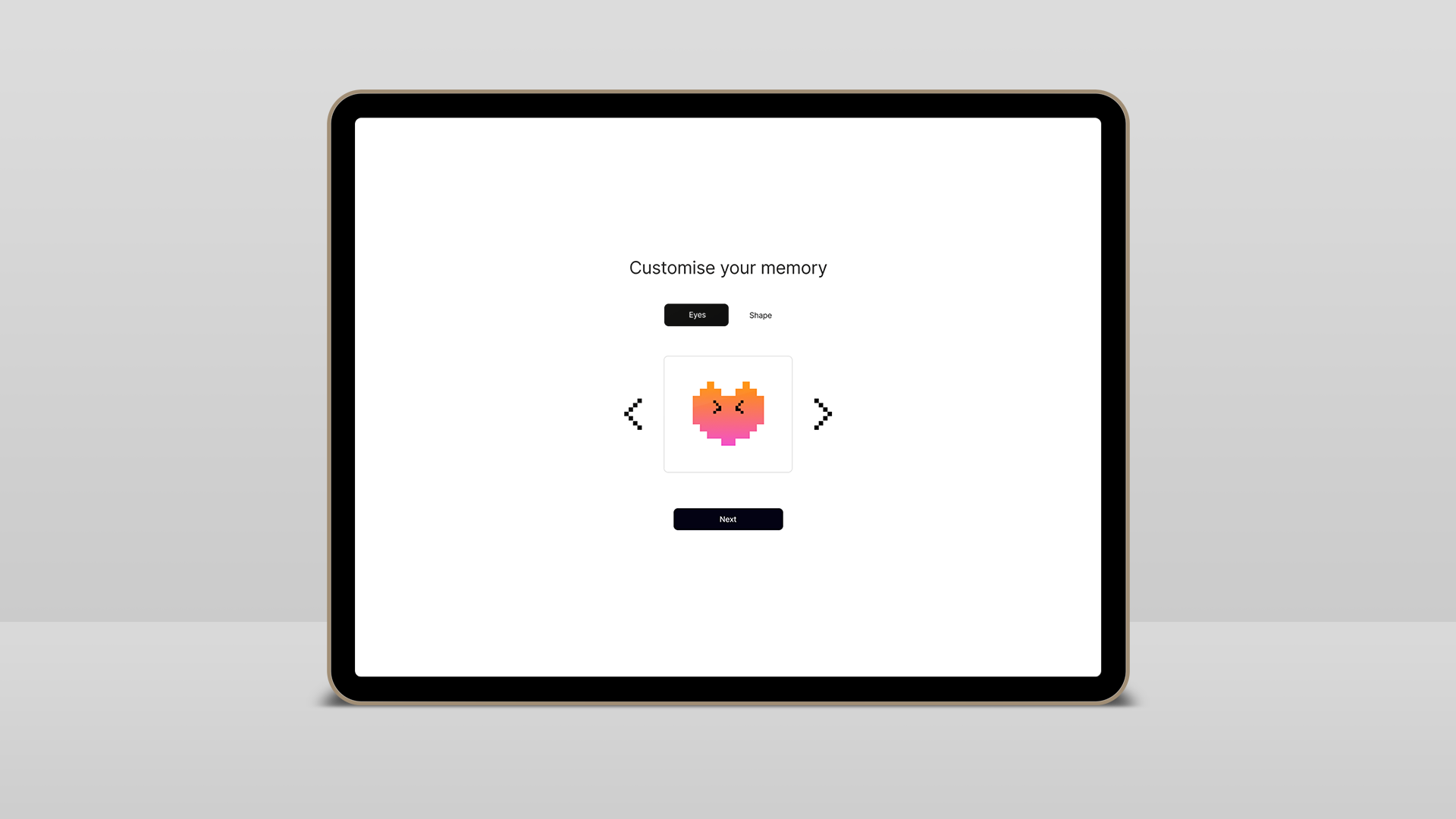
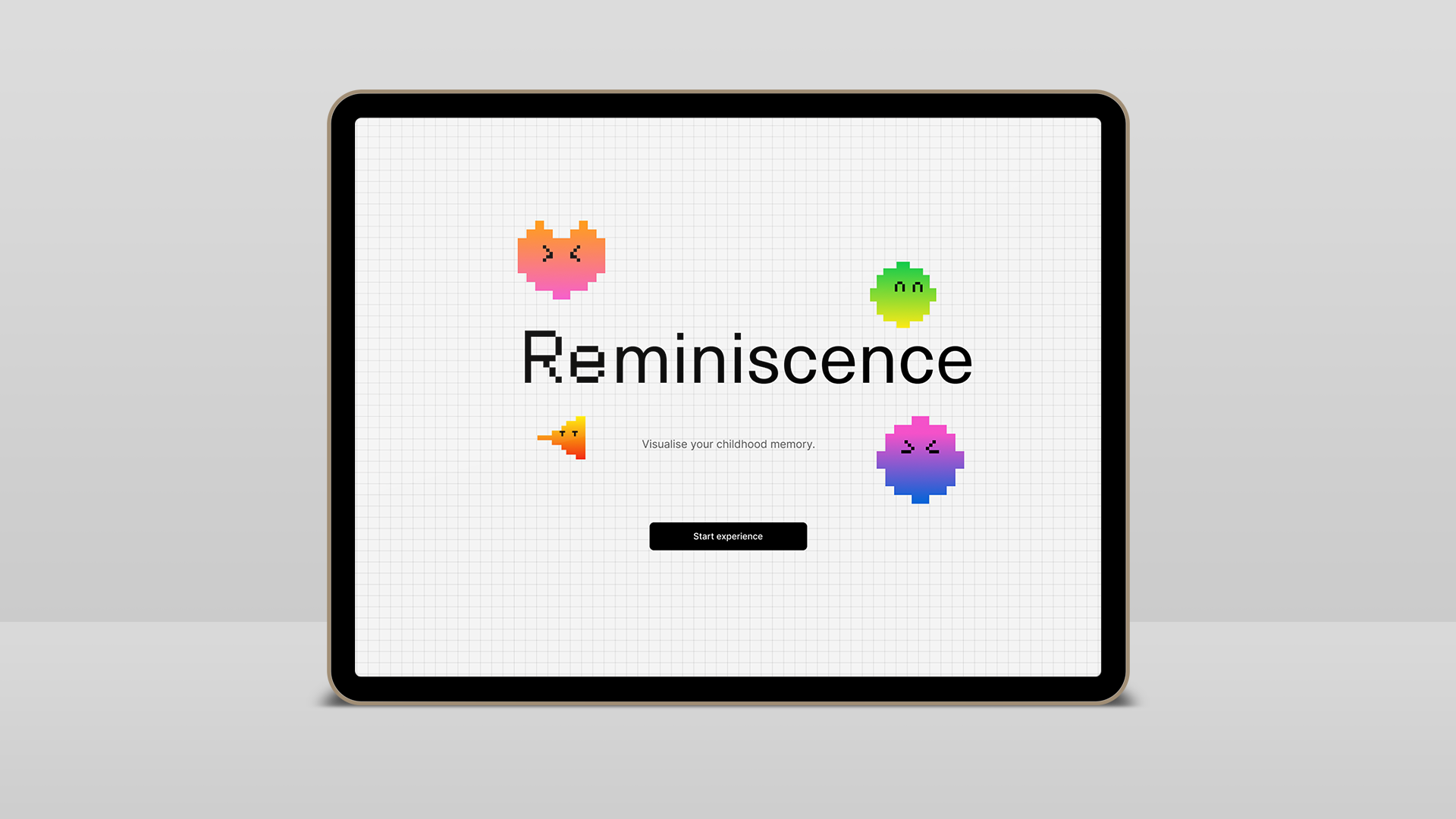
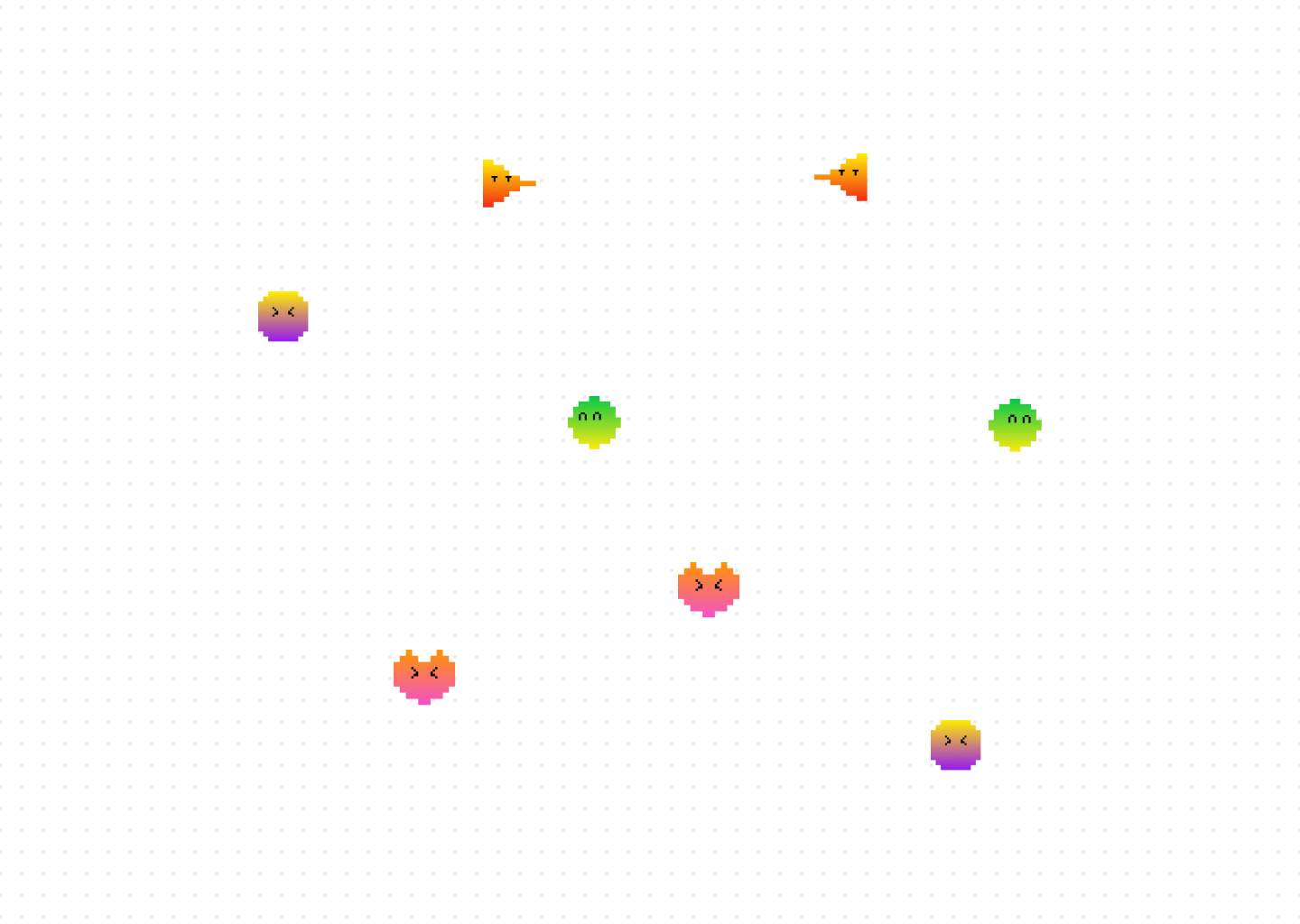
Several pixelated square character designs were developed, each featuring different body shapes and opacity levels. User feedback indicated that these early versions lacked clarity and visibility. Reflecting on the findings from Experiment 1, gradient-based visuals were reintroduced as the foundation for the pixel characters. This approach effectively conveyed the idea that each character embodied a unique memory, while maintaining an abstract and nostalgic quality. Pixel-style eyes were incorporated to enhance emotional expression and individuality, ensuring that each character represented a distinct childhood memory. With the visual design established, the next experiment focused on developing the user flow and interaction design for the memory visualisation experience.
Experiment 3
Interaction design & User flow
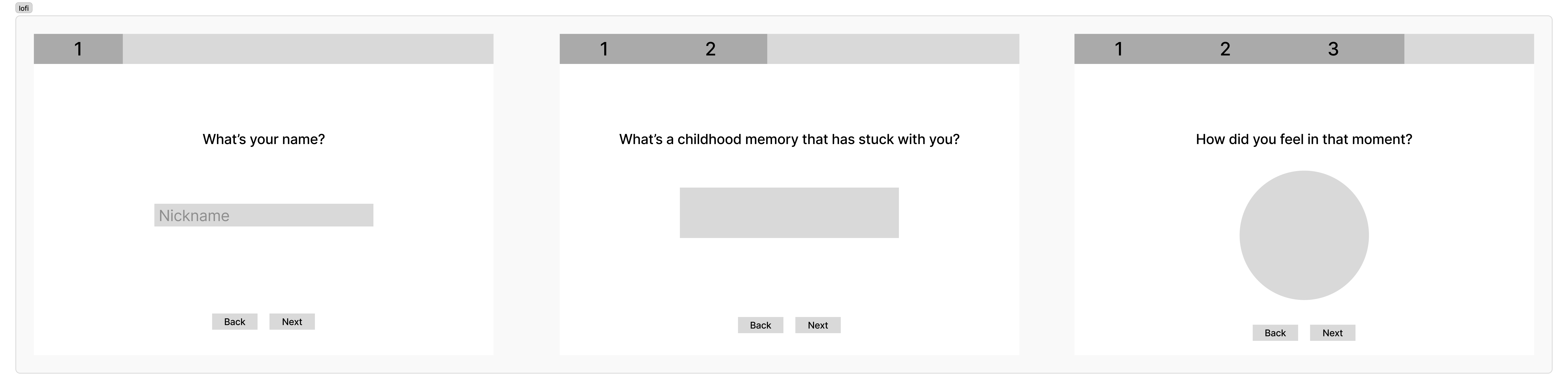
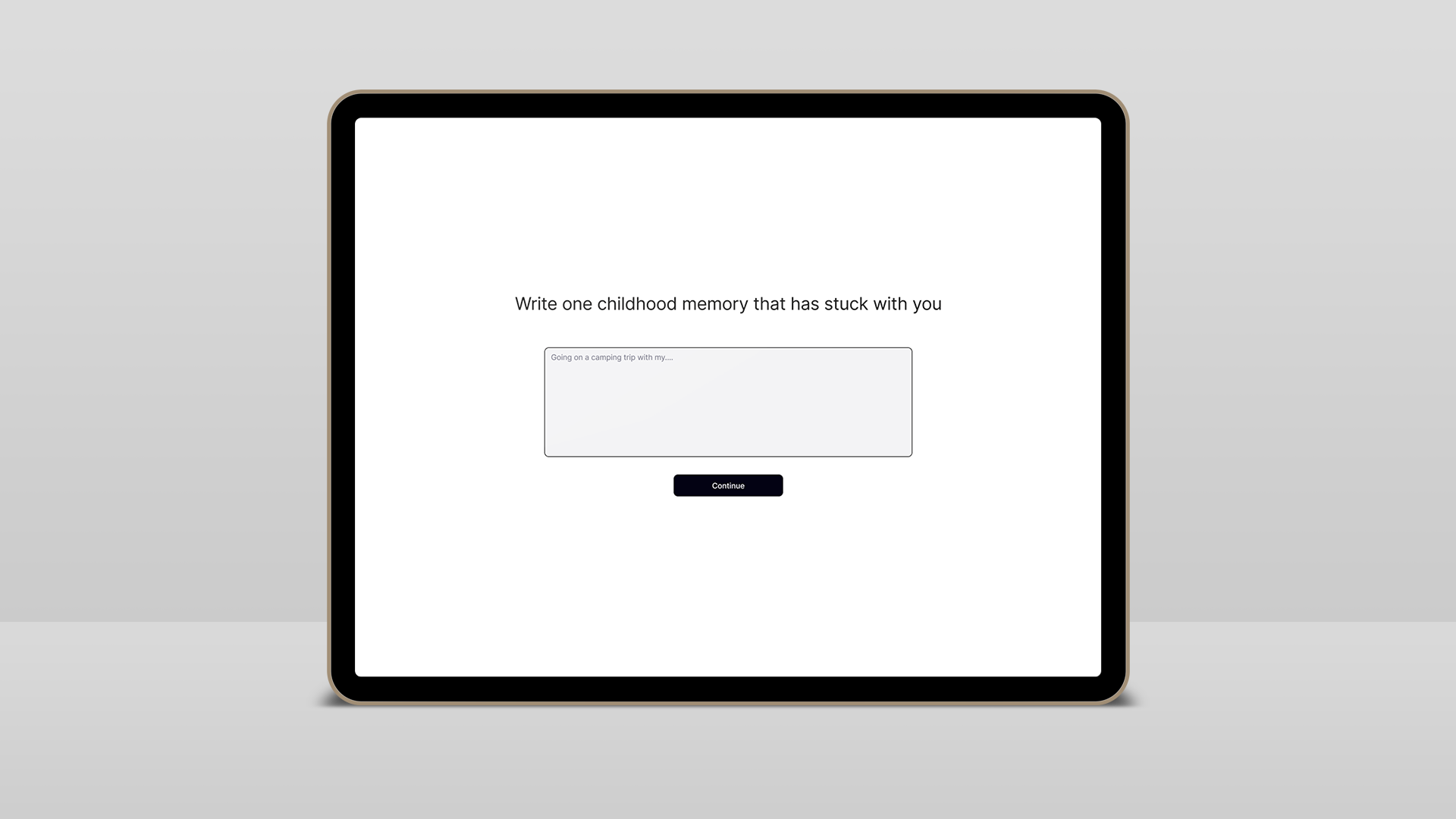
To create an experience that allowed users to recall and write about their childhood memories, a series of questions was developed and tested with peers and family members. The initial flow began by asking users for their name, followed by prompts to describe their memory, the emotions they felt, the sensory details they remembered, the people who were present, and the location of the event. While the questions successfully encouraged reflection, user testing revealed that the sequence lacked coherence. Participants expressed confusion about being asked their name at the beginning and were uncertain about the purpose of each question.
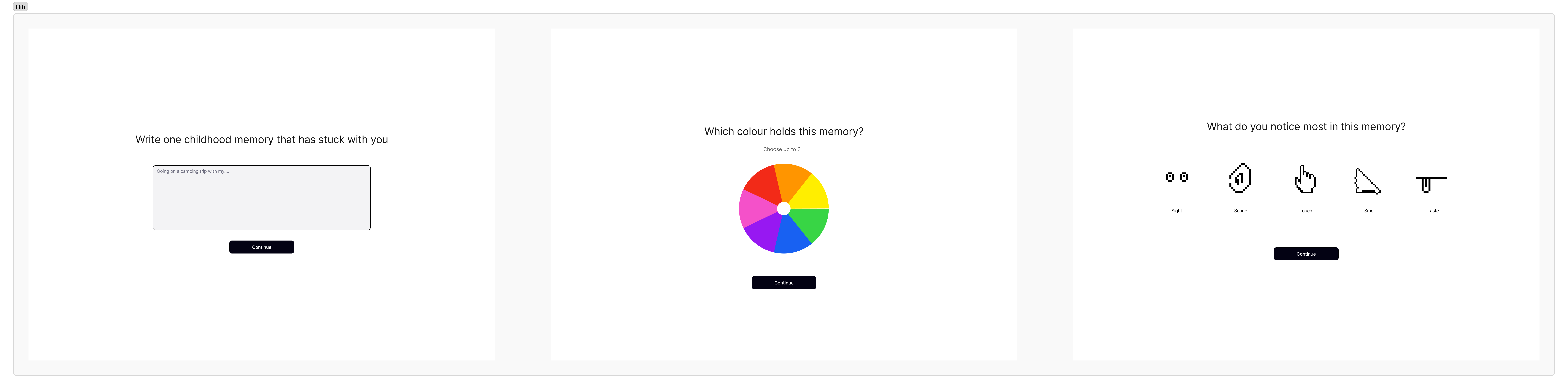
After several iterations, the question order was revised to follow a more natural and nurturing progression, allowing users to reflect freely before introducing personalisation. The final stage invited participants to name their memory and customise their visualised character, adding a more intimate and emotionally resonant touch to the overall experience. With the interactivity and user flow refined, the next experiment focused on exploring how to connect users through their individual memories.
Experiment 4
Connecting through individual memories
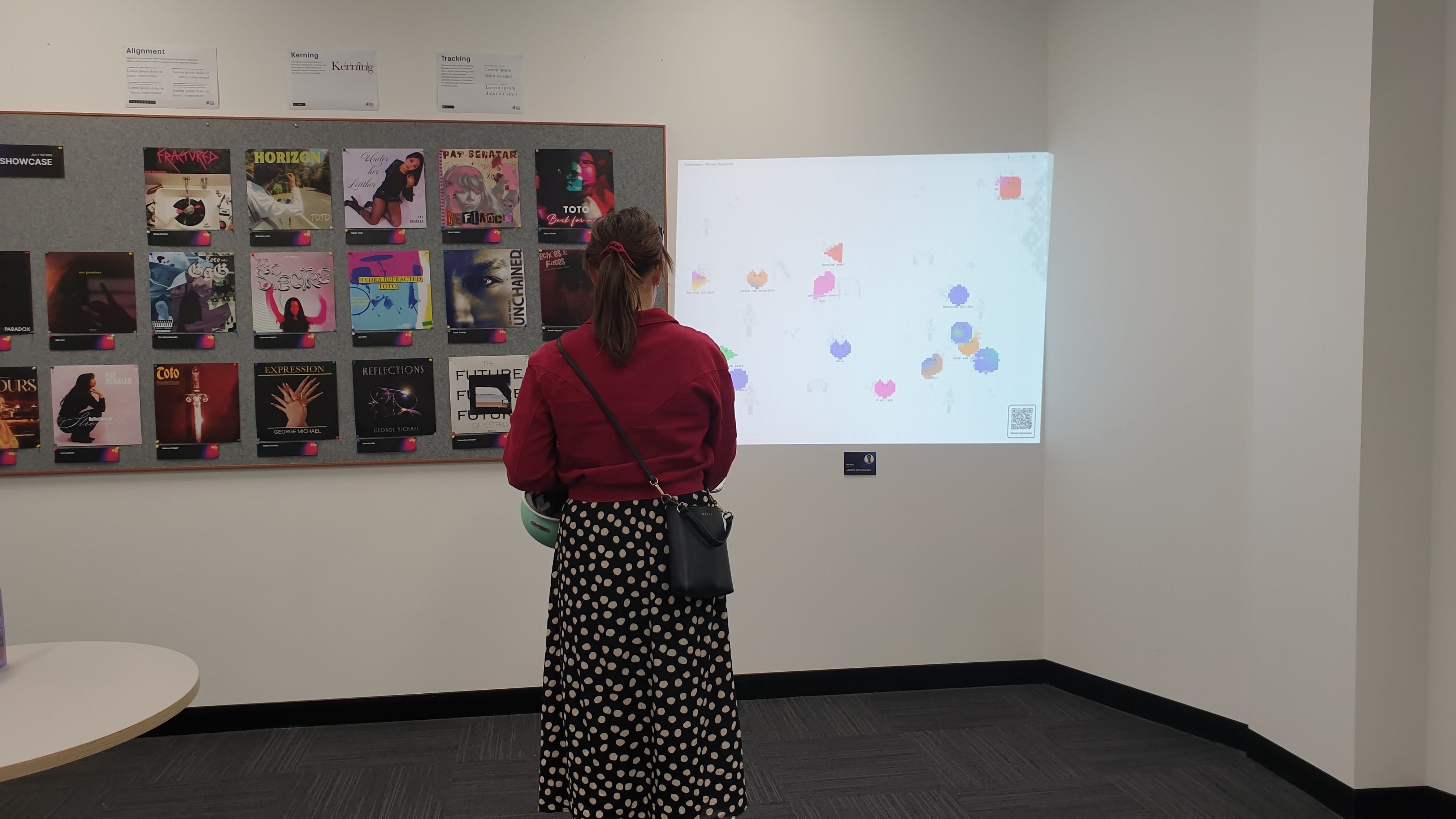
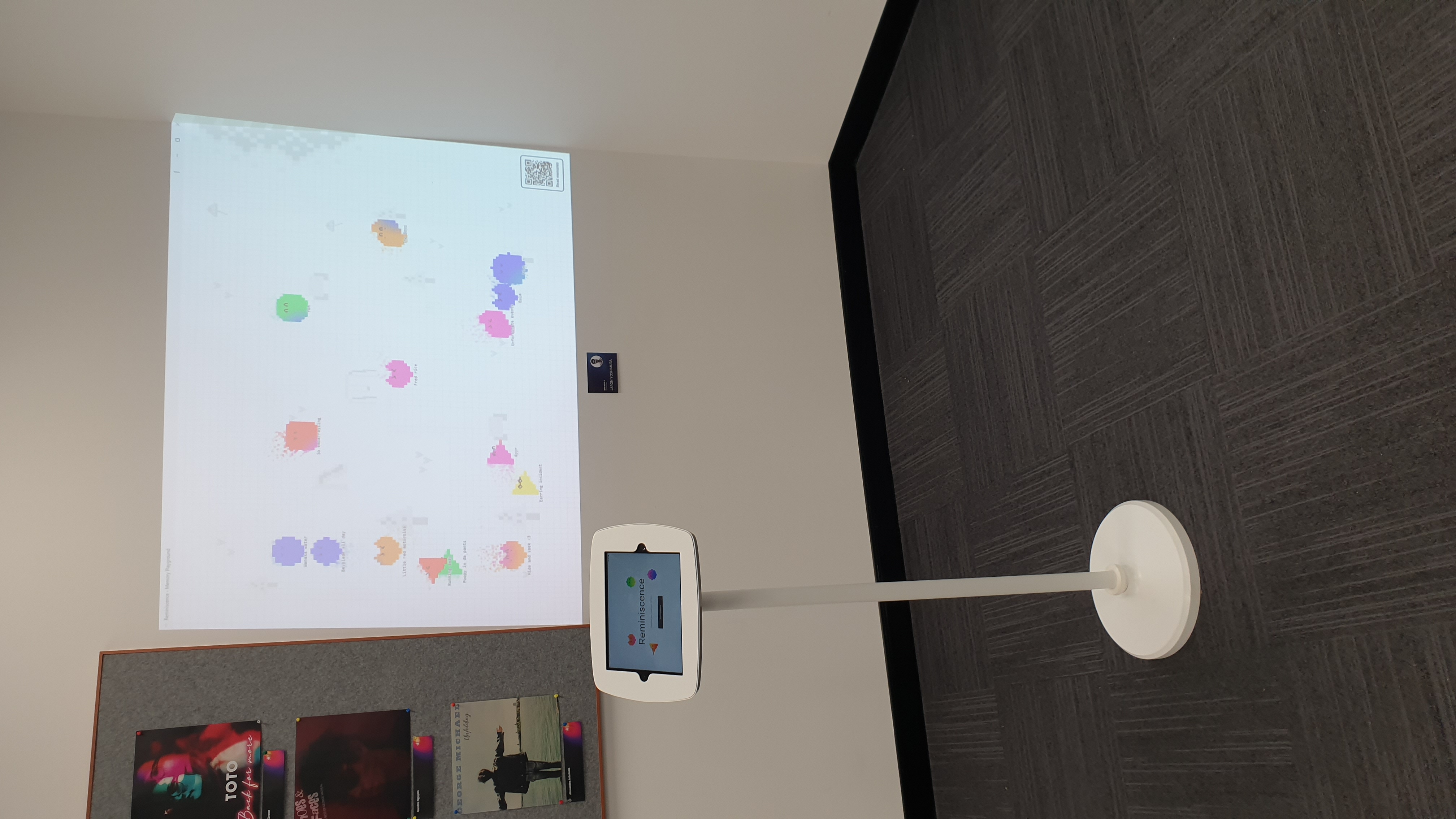
The goal of the final experiment was to create an experience that encouraged users to feel connected through their childhood memories. To achieve this, a shared digital environment named Memory Playground was developed. Within this space, each submitted memory appeared on the screen alongside its title and moved freely in dynamic motion. The direction and trails of each memory’s movement varied based on the responses given during the submission process, ensuring that each visual outcome remained unique. On the visual side, multiple background designs were tested, including checkered, canvas, and bitmap textures. User feedback indicated that the bitmap background was most effective conceptually, although it initially appeared too empty.
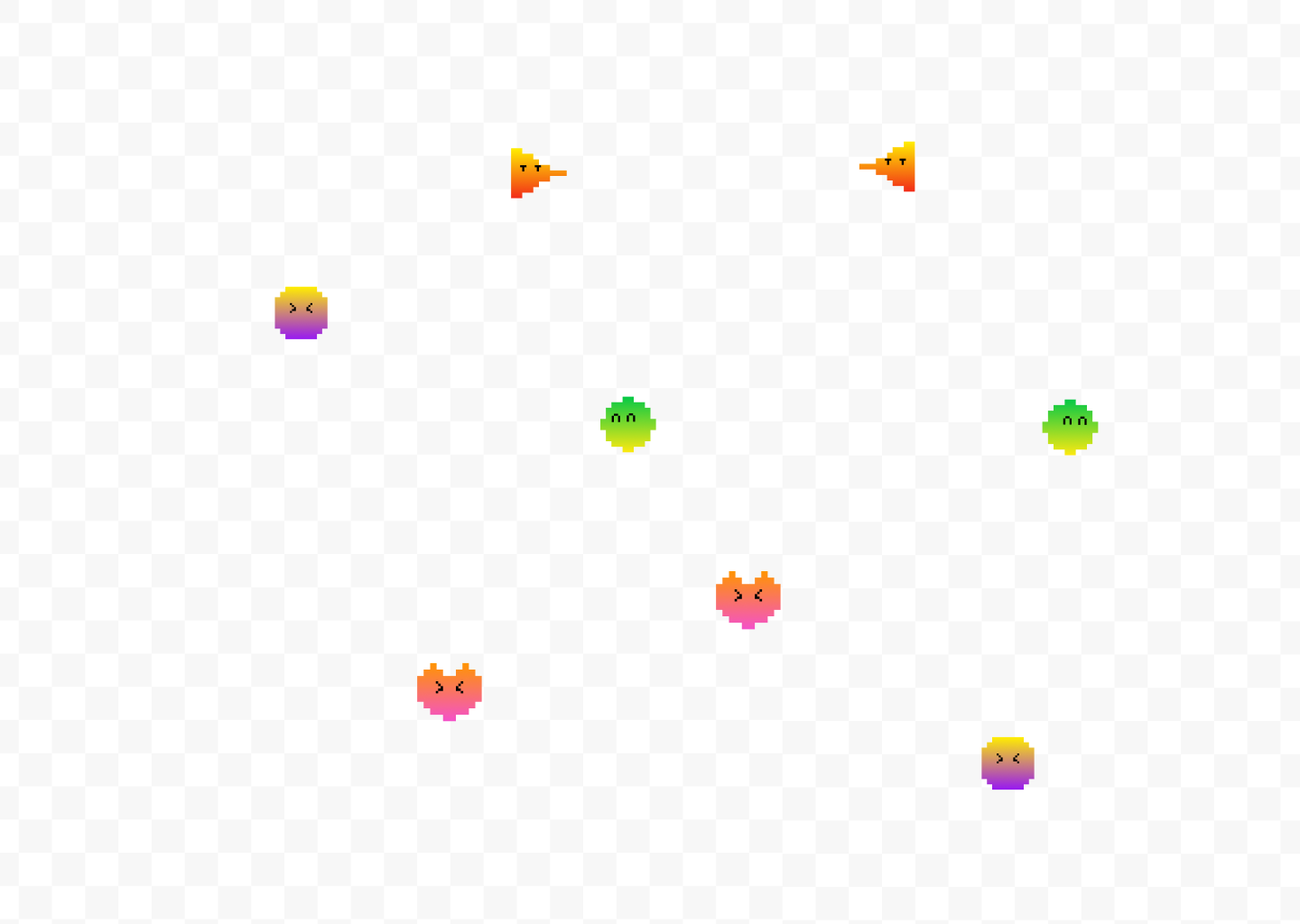
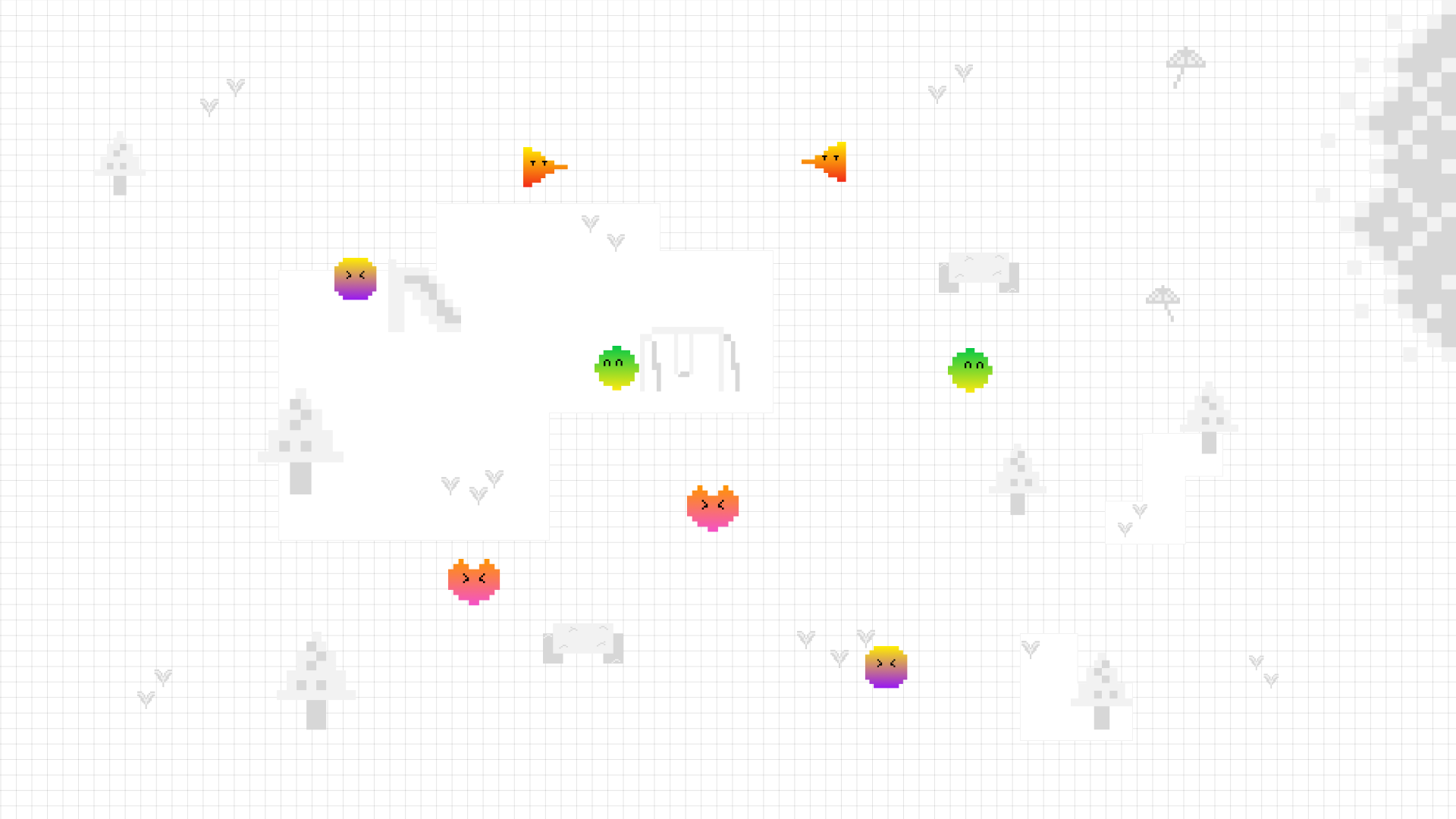
Drawing inspiration from the project’s theme of childhood, the idea of incorporating a playground setting was explored. Several stylistic variations were tested, and a greyscale background was chosen to ensure that the memory visuals remained the focal point. This design choice reinforced the idea of childhood memories as distant yet vivid experiences, faded over time but still present and alive within us. Participants responded positively to seeing their memories appear within the shared space, often sparking conversations about the individuality of each memory and the emotions they represented.
Outcome
At the end of year showcase exhibition, I set up the installation for the public to interact with, and the response was overwhelming. A huge number of memories were submitted, some full of personal story and others genuinely hilarious. The project sparked real joy in the people who engaged with it, and many were eager to add their own memory and watch it take shape on the projection alongside everyone else’s.